

Start with a map
How I use maps to navigate beginnings — and the search for meaning

“There are two Timbuktus. One is the administrative centre of the Sixth Region of the Republic of Mali… And then there is the Timbuktu of the mind — a mythical city in a Never-Never Land, an antipodean mirage, a symbol for the back of beyond or a flat joke. ‘He has gone to Timbuktu,’ they say, meaning ‘He is out of his mind’.”
— Bruce Chatwin, Anatomy of Restlessness
In the summer of 1881, the Scottish writer Robert Louis Stevenson went to stay with his parents at a rented cottage in Perthshire. He spent much of his time walking the nearby glen in mizzling rain, when midges clouded the riverbanks in puffs of shimmering grey. He also wrote, but at this early stage in his career, it was only essays and short stories — work he was paid for, though not enough to live on. (‘Anybody can write a short story–a bad one, I mean,’ he remarked, ‘but not every one may hope to write even a bad novel. It is the length that kills.’) Full of cold from his Perthshire sojourn, Stevenson travelled on to Braemar, where he convalesced at a cottage owned by a Miss McGregor. Among the other lodgers was a schoolboy home for the holidays. Each day Stevenson would watch the child paint using a shilling box of watercolours. With rain rattling the windowpanes, Stevenson could neither hike nor write, so he decided to join the boy with his paintbox:
‘I made the map of an island. It was elaborately and (I thought) beautifully coloured; the shape of it took my fancy beyond expression; it contained harbours that pleased me like sonnets; and with the unconsciousness of the predestined, I ticketed my performance ‘Treasure Island.’’
This insight into the creative process appears in Stevenson’s 1894 essay, ‘My First Novel’, published in The Idler a decade after the novel that established his reputation. It’s an essay I go back to, not only because Treasure Island was one of the early books to catch my childhood imagination, but because Stevenson perfectly describes how I still feel about maps, and more particularly, how maps possess both magical and practical properties in the stories they conceal:
‘I am told there are people who do not care for maps, and find it hard to believe… The names, the shapes of the woodlands, the courses of the roads and rivers, the prehistoric footsteps of man still distinctly traceable up hill and down dale, the mills and the ruins, the ponds and the ferries, perhaps the Standing Stone or the Druidic Circle on the heath; here is an inexhaustible fund of interest for any man with eyes to see or twopence-worth of imagination to understand with!’
That ‘inexhaustible’ feeling is something I remember from my childhood — the desire to get inside every map, to get closer to the places they might describe. One birthday, I was given a W.H. Smith globe, which doubled up as a bedside lamp. I was scared of the dark — I still am — but the soft glow gave me comfort. If I were lying awake worrying about something in the night, the lamp could somehow draw me into lines of thought that had nothing to do with where I was. Maps still have that effect on me. They take me out of myself as much as they suggest a way into somewhere or something else.
I’ve written about this before, how maps seem empty where there’s desert, and then you zoom in closer and discover a lost ocean in the Sahara. Story is written into the place names — a Valley of the Whales, a Place of Floating Seashells. The same with water, in the way maps are largely wordless where there’s a great sweep of blue. The A T L A N T I C has plenty of space to spread out across an ornamental globe in noisy capitals. The P A C I F I C has even more, while Lake Tanganyika in the middle of Africa is so long and narrow, you sometimes see the letters stacked vertically, like a streak of lightning. Go deeper into the charts used by mariners, and the detail intensifies in the mud and broken shale, in the sticky ooze of the ocean floor. Questions lurk in each notation. Magnetic anomalies. Isolated dangers. Reported, but not confirmed. ED (meaning ‘existence doubtful’). d (meaning ‘unexamined’). Maps are much more powerful, more multi-dimensional than they first appear.
It’s a theme I’ve explored at length in my most recent book, A Training School for Elephants. The story pivots around all sorts of maps, both 19th century and contemporary, including Joseph Conrad’s memory of his childhood atlas dating from the 1850s, and the promise he’d made to his school friends that one day he would reach those ‘Regions Unknown!’ in the middle of Africa (you can read about it in Geography and Some Explorers — an important essay written in the last year of Conrad’s life, which I discuss in this episode of my podcast, Gone to Timbuktu, with the Norwegian philosopher Erling Kagge). But for Conrad, it was an ambition cut short. Following the European ‘discovery’ of Lake Tanganyika in 1858, he pencilled in the outline of the lake where the ‘blank’ space on his old map used to be. By 1890 when Conrad eventually travelled into the African interior himself, Congo was King Leopold’s private colony. Conrad experienced the stark opposite of the idealised space he’d imagined as a child. ‘It had got filled since my boyhood with rivers and lakes and names. It had ceased to be a blank of delightful mystery – a white patch for a boy to dream gloriously over. It had become a place of darkness.’ Instead of wide-eyed adventure, Conrad reinforced the opposite trope: universal criminality and impenetrable forest.
I like maps, because they lie.
Because they give no access to the vicious truth.
Because great-heartedly, good-naturedly
they spread before me a world
not of this world.

— Wisława Szymborska, ‘Map’, trans. Clare Cavanagh, New Yorker, 7 April 2014.
In the late 17th century, Semion Remezov drew up the first significant cartographic record of Siberia for Peter the Great. My British publishers used a couple of them as end papers to my 2020 book, The Lost Pianos of Siberia. I think they are ravishingly beautiful.
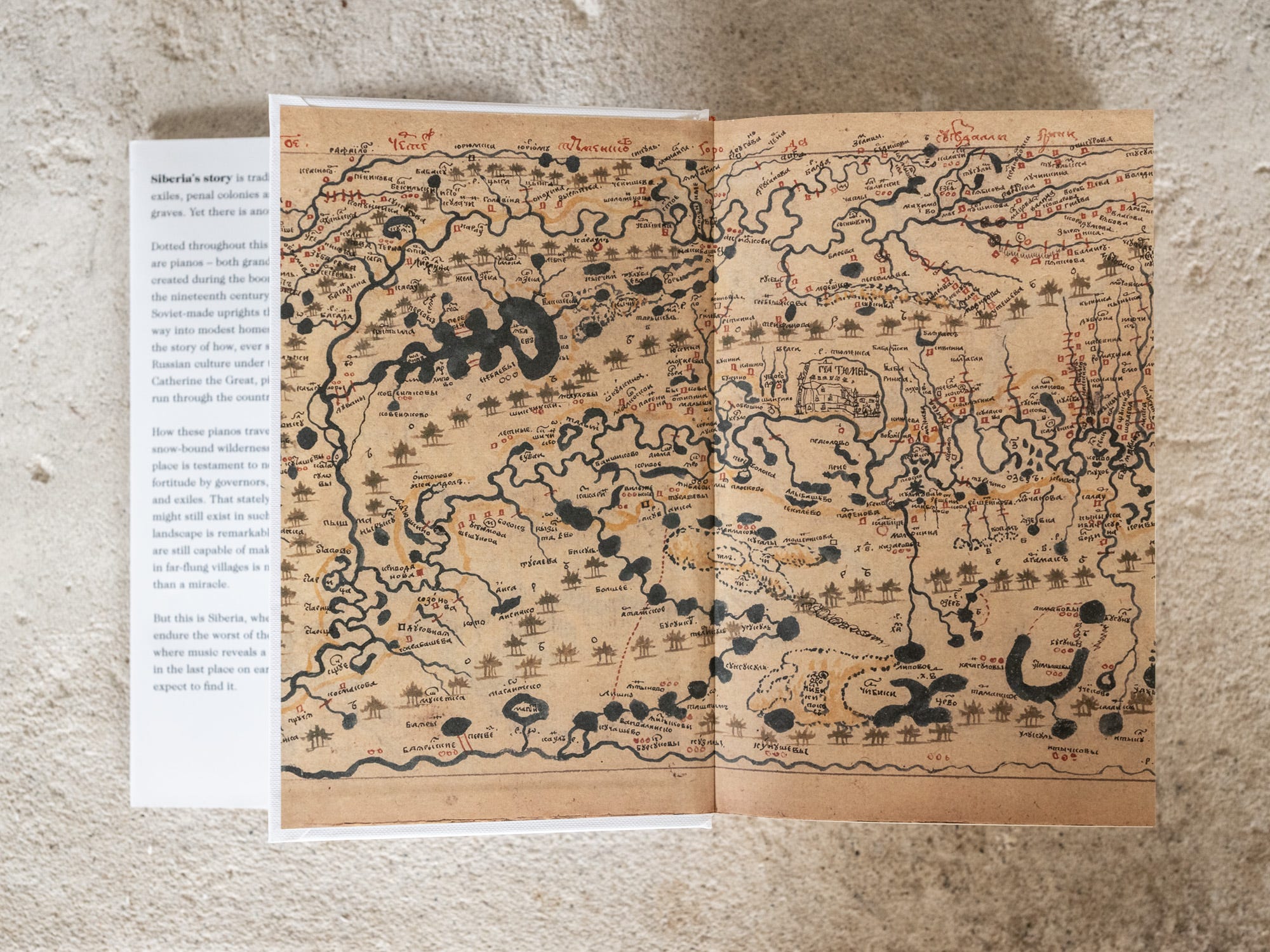
The original maps are in Harvard University. I encountered copies in the western Siberian town of Tobolsk. I found them bewitching — and still do. They speak to the optimism maps can inspire, in the way they imply infinity. The rivers slip off Remevov’s pages in beautiful calligraphic loops. Painted in watery blues, the tributaries reach across each folio like the veins of the human heart, the spurs as finely drawn as a fishbone.
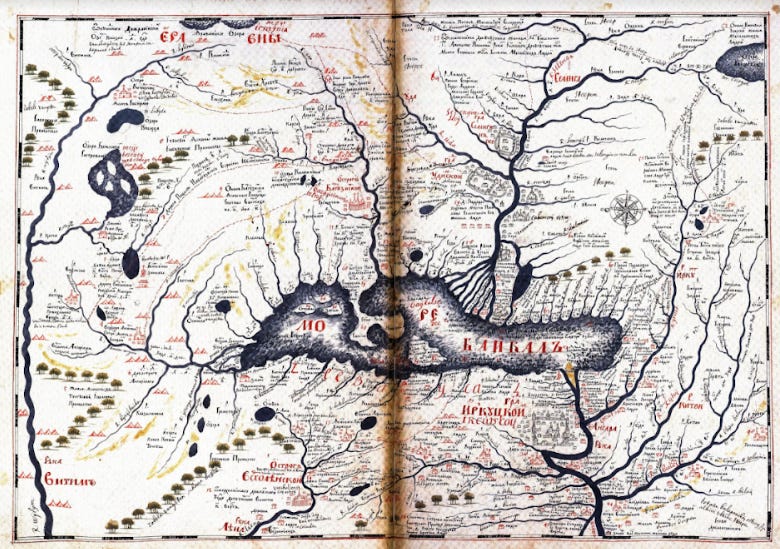
Tiny details come alive: elaborately inked fortresses, sickle lakes, wooded copses. The maps are dotted with Siberian creatures: flying horses, a pack of wolves, horned antelopes. This is Siberia depicted with a delicacy that belies its ferocious reputation, in the fraying rivers spilling into lakes the shape of love-hearts, to the forest hollowed out by lazy streams making their northern journey to the Arctic. In Remezov’s maps, Siberia burns with possibility, in the faults and folds of a landscape full of risk and opportunity, in the way the forest is scrawled with curling waterways and tightly folded S-bends. It’s as if the land is whispering somehow. Siberia. Siberia. I wrote about that too, how the word makes everything it touches vibrate at a different pitch. Early Arab traders called Siberia Ibis-Shibir, Sibir-i-Abir and Abir-i-Sabir. Modern etymology suggests its roots lie in the Tatar word sibir, meaning ‘the sleeping land’. Others contend that ‘Siberia’ is derived from the mythical mountain Sumbyr found in Siberian-Turkic folklore. Sumbyr, like ‘slumber’. Or Wissibur, like ‘whisper’, which was the name the Bavarian traveller Johann Schiltberger bestowed upon this enigmatic hole in fifteenth-century cartography
But I digress, which is always the risk with maps. It’s easy to get lost in their plenitude — and that abundance of topographies and etymologies written into place names. But maps are also useful to circumscribe a thought. Maps exert power. They can give us a godly perspective, a dangerous omniscience. From an elevated place, maps can make the impossible seem approachable. They can also make sense of a quest, which is perhaps why they’ve played such a significant a role in the stories I’ve wanted to pursue.
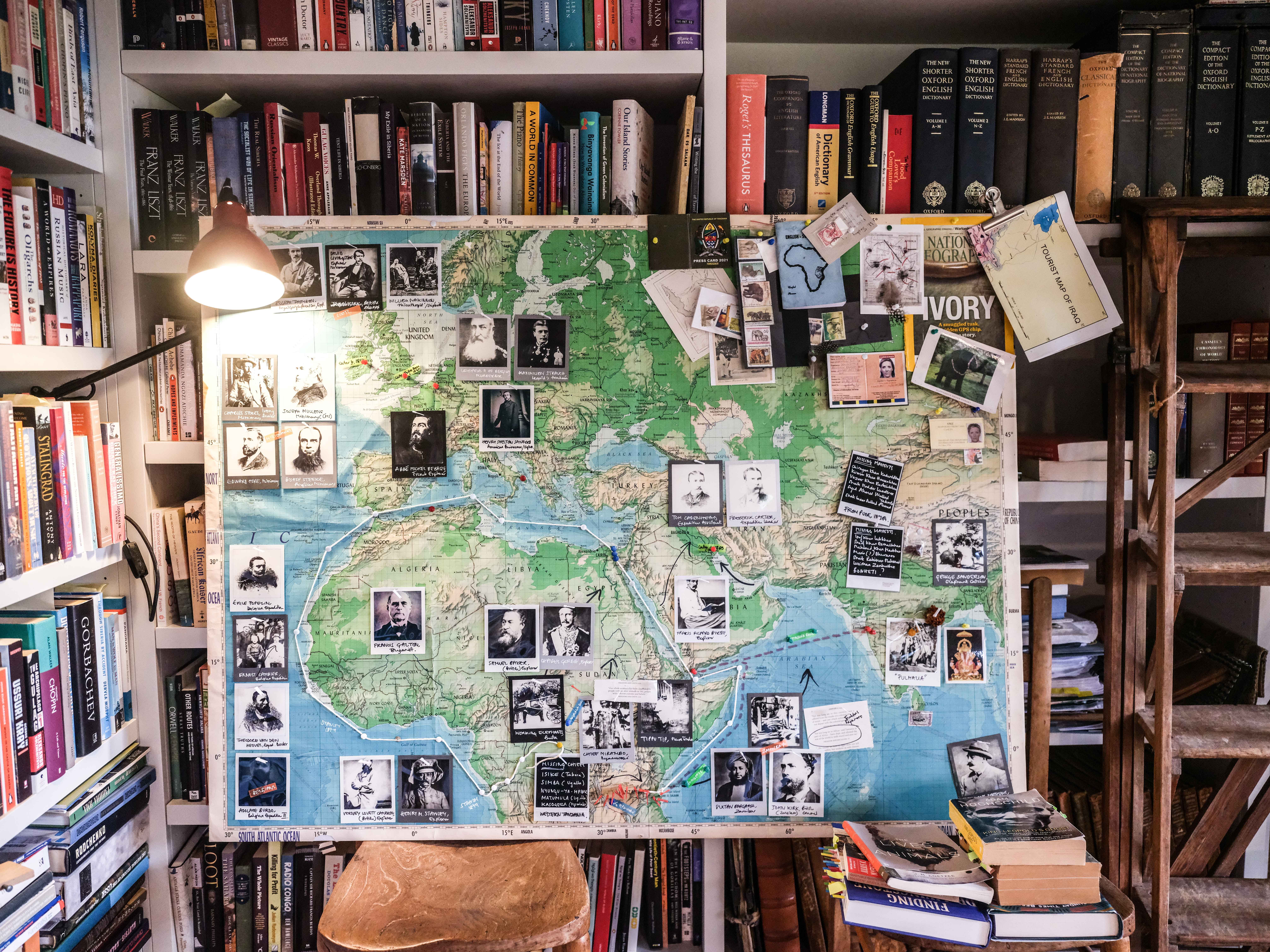
Ever since I started training to be a journalist in the 1990s. I would rip out leads in newspapers, and tape them on to my apartment wall where they would yellow in the sun. I’d layer them up, often using maps, which was my method of anchoring a story to a place. I’d pin the clippings side by side, sometimes purposefully, usually haphazardly. Positions would alter. Lines of enquiry would multiply and fizzle out. New connections would sparkle attractively, or confoundingly, to reveal a logic or unlikely dissonance. My husband, who thought they looked like evidence boards in murder investigations, called them my serial-killer walls. This is the one I made for A Training School for Elephants. It hangs in the office where I work.
Which takes me back to Robert Louis Stevenson’s essay:
“It is my contention — my superstition, if you like ‚ that who is faithful to his map, and consults it, and draws from it his inspiration, daily and hourly, gains positive support, and not mere negative immunity from accident. The tale has a root there; it grows in that soil; it has a spine of its own behind the words. Better if the country be real, and he has walked every foot of it and knows every milestone. But even with imaginary places, he will do well in the beginning to provide a map; as he studies it, relations will appear that he had not thought upon; he will discover obvious, though unsuspected, short-cuts and footprints for his messengers; and even when a map is not all the plot, as it was in Treasure Island, it will be found to be a mine of suggestion.”
So you can see how this goes: I follow maps into ideas. They help me navigate place, history, a narrative structure. Maps are where I need to begin, to work out where I’ll go and what I want to say in these difficult, liquid times.
You've given me an idea - thank you! I wonder how travel writing will change with Google Maps etc now showing us the way? I find them so... contextual-less. Without poetry. Resonance. Spoken instructions down a Sat Nav on a road trip -- they are so deadening... So different to journeying with a paper map, don't you think? Or maybe not. I need to think about this idea, of what digital mapping is doing to the human imagination.
And thanks, too, for making the first comment Annette! I'm quietly trying my hand at this Substack thing... It's interesting. More space for nuance than Instagram, which I have used for years.